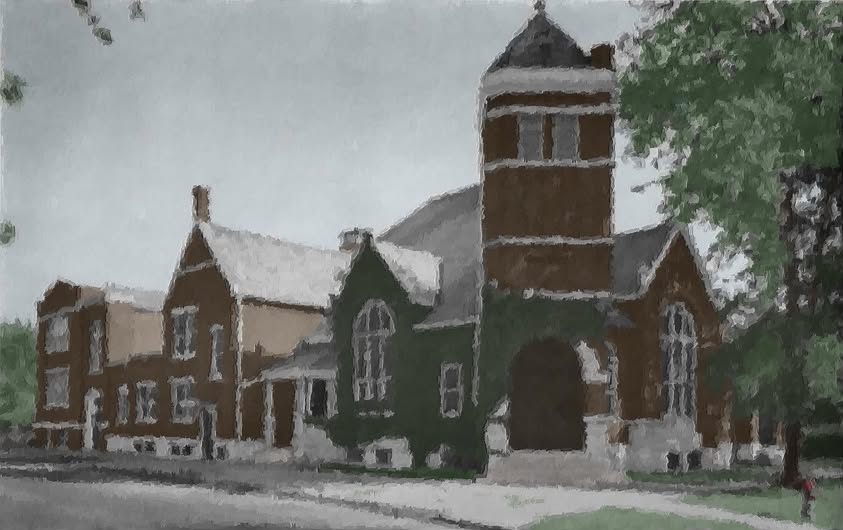


On February 7, 1849, the Presbytery of Sangamon met in a called meeting to consider the petition of forty-four men and women, who had been granted certificates of dismissal by the First Presbyterian Church, so they could organize a new congregation. The petition was granted, and the Reverend Thomas Galt was appointed to proceed with the organization of the new church. A meeting was held on the evening of the same day. The name chosen was The Third Presbyterian Church, and three ruling elders were elected: Asahel Stone, James L. Lamb, and Edmund R. Wiley. A call was extended to the Reverend R. V. Dodge of Terre Haute, Indiana to serve as Pastor. (Continued below).
In the course of the next few months a commodious sanctuary was built at the northwest corner of Sixth and Monroe. It cost $12,000, and was quickly paid for. The people had a mind to work; they were interested in growth in grace and in the preaching of the gospel of grace. In less than a year, the Sunday School enrollment had reached 250. Dr. Dodge accepted the call to the pastorate on March 29, 1849, and served with great fidelity until October 29, 1857.
Our church was a down-town church. The membership was made up of the leaders of the city and their families; they appreciated excellent preaching and helpful Bible exposition. The men who filled the pulpit were outstanding: C. P. Jennings, who went from here to Shelbyville, Indiana, and Cleveland, Ohio; G. W. F. Birch, who served as pastor of the Second Presbyterian Church of Lexington, Kentucky, and was a great defender of the faith; Henry M. Paynter, who went to New York City, and did a great work as a Bible teacher. During Dr. Birch’s pastorate, it was necessary to build a larger church. The old building (17 years old) was sold to the Second Methodist Church (now Kumler) and a new building was built on the northwest corner of Seventh and Capitol at a cost of $70,000. This was in 1867 and in the depression which followed the Civil War, it was impossible to pay the debt of $20,000. In 1872, the First Presbyterian Church bought this building from us, and welcomed the majority of the members of our church into its membership by transfer.
In 1873 a frame building was built at the northeast corner of Sixth and North Grand. The membership was twenty-three and the minister was Dr. Paynter. We could have gone to the east side as our church had opened up a Sunday School in 1866 in the Wabash shops, which later became the Brainerd Chapel, from which Fifth Church was organized. We could have gone to the west side as our church had a Sunday School at the corner of Rutledge and Carpenter. We decided that the best opportunity for Christian work was in the north end. This part of the city was sparsely settled; the old Watch Factory was not opened up until that year. The old rolling mill came later, about 1880. There was no transportation in those days to Oak Ridge. Even Lincoln Park was not opened. Nevertheless, in a little while, a large Sunday School was flourishing. By the middle of the 1880’s, the enrollment had gone over 300. The superintendent of the Sunday School was the editor and publisher of a Sunday School paper, which was held in high esteem by folks who loved Bible teaching. The pastors who served in the little frame church were J. I. Gulick, who went from here to Mason City, Illinois; A. K. Bates; F. M. Baldwin, who lived to be over 90 years of age, and organized many Sunday Schools, especially in the south; and E. S. McMichael, who died in 1889, and whose body is buried in Oak Ridge.
In 1890 the church at Seventh and Bergen was built. It was built on the Akron plan, because we were doing a great work in our Sunday School. It cost $15,000, exclusive of the donated labor, and there was considerable of that. The pastor was Dr. Gerrit Snyder. He had built the Belden Avenue Church in Chicago, and was just the man to super- vise the building of our church. In the course of his long ministry, he built seven new churches. Dr. Snyder was a very successful personal worker. One of his contributions to evangelical literature was a study of the Book of John as an aid to the personal worker. During his time, Christian Endeavor flourished and there were societies for all ages. About 1891 the Sunday School in Ridgely was started. It was housed for a good many years in a large residence at the northeast corner of 15th and Sangamon, and was known as the Lavinia Beach Reading Room; out of this came the Clementine Memorial Church.
Dr. James Elkana Rogers became the pastor in 1895. He had been a missionary in Persia, and had served as the president of Black- burn College. He was a scholar and a mighty preacher. He excelled in every way. During his ministry, the membership reached 555 communicants. Among the evangelists who gave fine leadership in those days was Dr. Elmer P. Loose. The church, in every department, was enjoying the finest leadership. Night after night, there were Bible classes; at least three of the elders were outstanding Bible teachers. These were the men who were the leaders in the County Sunday School Association, in the Sangamon Co. Bible Society, and in every form of Christian service. Elder John S. Vredenburgh II was one of them. The manse is the Vredenburgh Memorial and it was built in 1902 with money bequeathed by him. Elder Vredenburgh was ordained to the eldership in 1873, and was the son of Elder John S. Vredenburgh I, who was ordained as an elder in our church in 1856. The churches in Mason City and Petersburg are among those who remembered his ministry in Bible conferences. In 1908 Dr. Rogers accepted a call to the professorship of Bible and Philosophy at Carroll College.
From 1908 until 1914, the Reverend Frank H. Given was the pastor. He came from Cincinnati, Ohio, and was a native of Paxton, Illinois. He was a man of prayer. During his ministry, the Sunday evangelistic meetings were held in the city, and two hundred converts were added to the church. In those days, as many people attended the midweek meeting as the Sunday morning service. At the beginning of his pastorate, there had been considerable dissension but at the close, the church was unified. When this work was done, Mr. Given went to Kirkwood, Mo., his last work.
In June 1914, the Rev. H. M. Hildebrandt came from Petersburg, Illinois, and began his long ministry. At that time, the church membership was 280, and the Sunday School enrollment was 292. The elders were William Watkins, John Fernandes, Oliver Lawrence, A. H. F. Wortman, and John F. Ferreira. There was a small Christian Endeavor society, but no missionary society. Mrs. George Meredith was the organist; the church quartette consisted of Miss Anna Ray (now Mrs. Bandy), Mrs. Mary Nass, Mr. W. J. Aurelius and Mr. J. E. Schwarzott. Mr. Mark S. Evans was the superintendent of the Sunday School and Mr. J. Russell Haynes was the secretary.
Mr. Hildebrandt was a leader in the movement in our denomination which used the slogan, “Every pastor his own evangelist.” He was fully persuaded that the Sunday School was the all-year round method for this kind of work. From the very beginning, he made the mid-week meeting the prayer-time for the Sunday School work, and the training opportunity for the teachers. Later on, he organized a Sunday School Teachers’ Training School, which continued for twelve years, and granted diplomas to 140 graduates; every one of them having finished a four year course, and having earned twelve credits. This ministry was an outstanding success. Out of it came several thousand, who accepted the Lord Jesus as their Savior, and who were willing to take their places as helpers in our church. The new addition, which was built in 1941-2 is the evidence of what can be done by consecrated Sunday School teachers and Christian workers. It cost $32,000, without the furnishings. It contained a children’s chapel, which has become the center of all of our work among the children. The children’s church was begun by the Reverend Harold Marx, who had charge of all of our young people’s work between 1936 and 1940. Miss Jeannette Smith succeeded him as our Director of Children’s Work.
There were city-wide evangelistic campaigns in 1915 under Dr. J. Wilbur Chapman; in 1924 under Gipsy Smith; in 1932 under Evangelist Grady Cantrall; and in 1947 under Jack Shuler. All of these meetings were enthusiastically supported by our workers, and increased the opportunity for a larger outreach. In 1931 Station WTAX offered us the opportunity to broadcast our evening service. This ministry continued for fifteen years-thirteen years of the evening service, and two years of the morning service.
Our church was one of the first congregations in the country to use membership cards. In 1923, an arrangement was made by which these cards should be used as communion tokens. The Board of Deacons took the responsibility for distributing the cards, and has continued faithfully in this ministry of visitation. From eleven districts on the north side, and two on the south side, we have grown to a total of forty-four districts in the city, and one in the county.
In 1932, the Reverend Bertram Betteridge, one of our own young men, served as an assistant pastor. His assignment was the promotion of the work at Knox and South Fifteenth Street, which has developed into the Knox Presbyterian Church.
What the founders of our church wanted to do, we are still doing. During one hundred years, we have preached the gospel of the grace of God from this pulpit, and our members have been able to give a reason for their faith and their hope.